Water softener and filtration work in Pleasanton starts with your water, not with a product. Zone 7 Water Agency supplies Pleasanton's water, and the City of Pleasanton's 2024 water quality report lists average hardness of 86 mg/L for Zone 7 treated surface water and 309 mg/L for groundwater. On the USGS scale that runs from moderately hard to very hard, so your tap depends on the blend that reaches your address. Call (510) 544-1962 and we will test it.
We install softeners, whole house filters and under-sink units, and we service existing systems that have stopped working right.
Signs of hard water at home
What hard water leaves behind
- White scale on faucets, showerheads and the inside of kettles.
- Spots on glasses and dishes after the dishwasher.
- A water heater that rumbles or has lost capacity from sediment.
- Dry skin and stiff laundry after washing.
- Cloudy or crusted fixtures in guest bathrooms and the laundry room.
Test your tap before you spend money. A test strip from a hardware store gives a rough reading, and a lab test gives a precise one. Your water retailer's annual water quality report lists hardness by source.
Softener, filter or both?
| Device | Removes or changes | Does not do |
|---|---|---|
| Salt-based softener | Replaces calcium and magnesium that cause scale | Does not filter chlorine or chloramine. |
| Carbon filter | Reduces taste, odor and some chemicals | Does not soften water. |
| Reverse osmosis at one tap | Removes dissolved solids for drinking water | Not sized for the whole house. |
| Scale inhibitor | Reduces scale formation without removing minerals | Does not create soft water. |
Pleasanton's water is disinfected with chloramine. Standard carbon filters handle chlorine better than chloramine, so a filter for taste should be matched to chloramine, and a manufacturer's sheet will say what it handles.
Pleasanton's rules for water softeners
The City of Pleasanton Building and Safety Division publishes a handout for residential softener installation, revised January 2020 and written against the 2019 California Plumbing Code. It requires demand-initiated regeneration, NSF 44 certification and a salt efficiency rating of at least 4,000 grains of hardness removed per pound of salt.
The handout also requires the softener to discharge to the sanitary sewer with at least a one-inch air gap, outdoor hose bibs to stay on untreated water, and a certificate completed by a licensed C-36 or C-55 contractor. Because codes change, ask the division which edition and handout apply to your project.
When a softener stops working
Callers often ask for a system check before any price is given, and that is a good instinct. Common faults include a stuck valve, a salt bridge in the brine tank, a failed timer or control head, and resin that has worn out after years of use.
A service visit tests hardness at the softener outlet, inspects the brine tank and valve, and checks regeneration settings. If the resin is exhausted, we explain whether rebuilding or replacing the unit makes sense.
Where the softener sits in the house
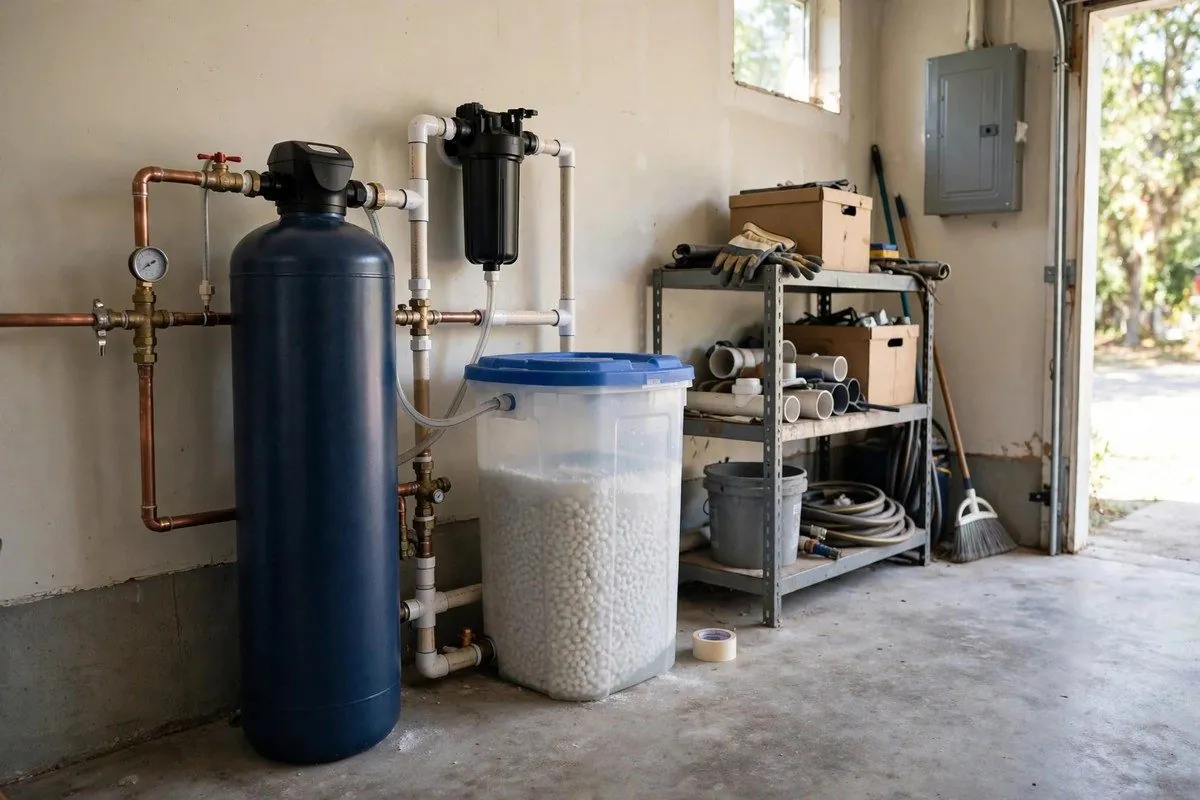
Most installations go in the garage or a utility closet at the point where the main water line enters the house. The unit needs a drain, an outlet and room for salt bags. We split the outdoor hose bibs off the softened line so landscaping does not get salty water.
Newer homes in the Callippe Preserve area often have a garage layout that suits a softener. Older homes closer to Downtown Pleasanton may require a longer pipe run to reach a drain.
What a softener or filter costs
| Factor | Effect |
|---|---|
| Size of the unit | Larger households and harder water need larger resin tanks. |
| Whole house or one tap | Point-of-use units cost less but treat less water. |
| Plumbing changes | Drain, bypass and hose bib work add labor. |
| Permit and certificate | Pleasanton requires the contractor certificate for softeners. |
| Service versus replacement | A control head repair costs less than a new system. |
We quote before work starts. Related pages include water heater installation and plumbing installation.
Tankless owners gain the most from a softener, and our tankless page explains the flushing schedule.
Questions we hear from callers
The City of Pleasanton's 2024 report lists averages of 86 mg/L for Zone 7 treated surface water and 309 mg/L for groundwater. Your address may get either or a blend, so test your tap and read your retailer's report.
The city publishes an installation requirements handout and a certificate that a licensed contractor completes. Ask the Building and Safety Division which permit applies to your project.
A properly working softener adds a small amount of sodium, which most people do not taste. We can leave a bypass tap for drinking water if you prefer.
It reduces scale on elements and heat exchangers, which can extend life in hard water. It does not replace annual flushing.
Yes. We test the water at the outlet, inspect the valve and brine tank, and tell you whether a repair or replacement makes sense.
Yes. A softener changes hardness. A filter removes particles, taste or odor. Many homes use both, and we explain which one solves your problem.