
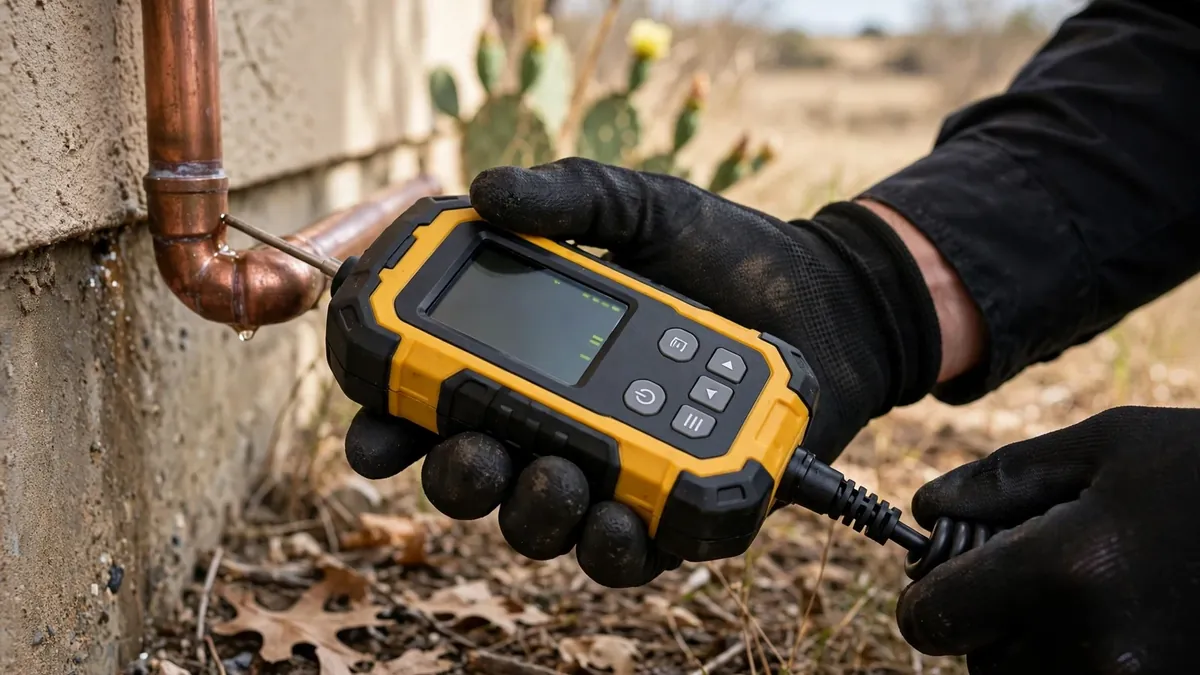
Emergency leak detection in Pleasanton is about finding the exact spot before anyone cuts into drywall or concrete. A leak you can see is easy. The ones that cost the most are behind a wall, above a ceiling or under a slab, where they can run for months. If water is actively spraying or pooling, shut off the main valve first and then call (510) 544-1962.
Start with the meter test
A five-minute check you can do yourself
- Turn off every fixture, the dishwasher, the washing machine and the ice maker.
- Open the meter box lid and press a finger over the sensor on the digital meter until the flow rate screen appears, which shows gallons per minute.
- The City of Pleasanton says 0.00 GPM means no leak, and any movement, such as 0.05 GPM, means a possible leak on the property.
- Close the main shutoff at the house and look again. If the reading drops to zero, the leak is inside the house. If it keeps moving, the leak is on the buried line between the meter and the house.
- Take a photo of the meter reading, wait an hour with the water off and photograph it again.
That simple split tells us where to look first. A leak inside the house points us to walls, ceilings and the slab. A leak before the house points us to the buried supply line, which is a different tool and a different repair.
How we find a hidden leak
| Method | What it detects | Best for |
|---|---|---|
| Pressure test | Whether a section of pipe holds pressure | Isolating a zone of the house. |
| Acoustic listening | The sound of water escaping a pipe | Slab and buried lines. |
| Thermal imaging | Temperature differences from hot water leaks | Walls, floors and ceilings. |
| Moisture meter | Water content in drywall and framing | Confirming the wet area. |
| Camera inspection | Visual look inside drains and cavities | Drain leaks and access spaces. |
Where leaks hide in Pleasanton homes
Pleasanton's housing stock spans several generations. Older homes closer to Downtown Pleasanton may still have galvanized or early copper lines that corrode from the inside, and pinhole leaks are common in aging copper. Newer neighborhoods such as Callippe Preserve usually have plastic or PEX, where leaks tend to start at fittings and connections.
Slab-on-grade homes hide supply lines under the floor, while homes with crawlspaces let us check pipes from below. Each layout changes where we look and how we get access.
Ceiling and wall stains
A brown ring on a ceiling may come from a roof leak, a bathroom above, an air conditioner drain or a supply line. We trace it. Thermal imaging often shows the path of warm water, and a moisture meter confirms how far the damage spreads.
If the stain is growing, put a bucket under it and avoid the room until we confirm that no electrical fixtures are wet. Photograph the stain with a date so your insurer sees how it progressed.
Leaks under the slab and in buried lines
A leak under a slab often announces itself with a warm patch on the floor, the sound of running water at night or a sudden jump in your bill. A leak in the buried line may show as a soggy patch in the yard that stays wet in dry weather. Both need listening equipment and a method to confirm the exact spot.
Once we mark the location, the repair options are covered on our slab leak repair and water line repair pages.
What to tell your insurer
Many policies cover sudden and accidental water damage but not the cost of the leaking pipe itself, and some pay for the access needed to reach it. Call your insurer before repair work starts, keep your bills and photos, and ask whether a leak locate report will help your claim.
What leak detection costs
| Factor | Effect |
|---|---|
| Size and layout of the home | More pipe to test takes longer. |
| Where the leak is suspected | Slab and buried leaks need more equipment than a wall leak. |
| Access | Finished floors and landscaping slow the work. |
| Number of tests | A single zone costs less than a whole-house survey. |
| Hour of the call | After-hours visits carry a premium. |
We tell you the price before the first test starts. If the leak sits in a drain line, our drain cleaning team may be the better fit.
Questions we hear from callers
Yes. The 24/7 line takes calls any hour. If water is actively flowing, close the main valve, then call and we book the first visit that fits.
Warning signs include a rising bill, a meter that moves with everything off, damp spots, musty smells, warm floor patches and the sound of water when no one is using it.
Often, yes. Listening gear, thermal imaging and moisture readings narrow the search to a small area, so any opening is as small as possible.
No. Irrigation, a running toilet or seasonal use can raise a bill. The meter test above separates a true leak from heavy use.
A single-zone check can take an hour or two. A whole-house survey of a larger home takes longer.
Some policies do when the leak causes covered damage. Ask your insurer before work starts and keep every receipt and photo.