
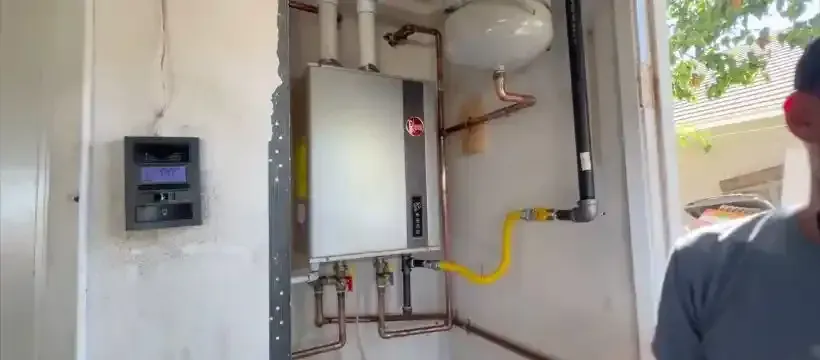
Water heater installation in Pleasanton is a decision with a deadline you control. You can choose the size, the fuel and the location instead of reacting to a flood. The work includes the heater itself, connections, venting, a relief valve and drain, an expansion tank where one is needed, and the permit. Call (510) 544-1962 to schedule a visit.
If your current heater has already failed, go to water heater replacement instead. That page covers the emergency swap, and this one is for planned work.
Questions to settle before installation day
A short pre-install checklist
- Where will the heater go, and is there a drain or pan nearby?
- Is the gas line sized for the new burner, or does it need upgrading?
- Does the electrical panel have capacity for a 240 volt circuit if you are choosing electric or heat pump?
- Is there a path for the vent, and does it meet the clearance rules?
- Is an expansion tank needed because the system has a check valve, backflow preventer or other normally closed device?
Choosing the type of heater
| Option | Fits when | Extra work |
|---|---|---|
| Gas tank, same location | The vent and gas line are in good shape | Often none. |
| Electric tank | No gas available or an addition | Dedicated 240 volt circuit. |
| Heat pump tank | You want lower running costs and have space | Condensate drain, airflow and electrical. |
| Tankless | You want endless hot water and wall space | Gas sizing, new vent and a condensate drain. |
If you are leaning toward a tankless unit, our tankless water heater page covers vent type, flow rate and flushing in more detail.
Expansion tanks and why closed systems need them
When a heater warms water, the water expands. If the system has a check valve, a backflow preventer or another normally closed device, the water has nowhere to go, and pressure rises in every pipe. A small expansion tank takes up the extra volume. Without one, the relief valve may drip and fixtures can wear early.
We test the house pressure with a gauge during the visit. If your supply pressure runs high, the same gauge tells us whether a regulator adjustment helps.
Venting, gas lines and electrical work
A gas heater needs a vent that rises continuously to the outdoors, with proper clearance from wood framing. A heater moved from one closet to another may need a whole new vent run. A tankless unit uses a different vent material and a condensate drain if it is a condensing model.
Electric and heat pump units need a circuit that matches the nameplate. If the panel is full or undersized, an electrician may need to be involved. We tell you before the day, not during it.
Permits and inspection in Pleasanton
The City of Pleasanton's water heater handout says a plumbing permit is required to install, remove, relocate or replace a water heater, so a new location or a fuel change needs one just as a same-spot swap does. We pull the permit and meet the inspector.
In a garage, the handout requires the heater to sit on an 18-inch platform unless it is listed as flammable vapor ignition resistant. Where a leak could damage a wood floor or an attic, it calls for a watertight pan with a drain. We check both before choosing a location.
The Bay Area Air Quality Management District has zero-NOx standards on residential gas water heaters when a unit is replaced. The compliance date was amended on November 4, 2026, so ask which model meets the rule on the day you install.
Installing near Pleasanton's hills and golf communities
Homes in Ruby Hill and the Callippe Preserve area tend to have larger floor plans, longer pipe runs and sometimes a second heater. A long run means a wait for hot water at the far bathroom, and a recirculation pump or a second heater may make sense. We look at the layout before recommending a tank.
Older homes closer to Downtown Pleasanton may still have the original small closet and a flue designed for a different era. We measure and tell you what the new heater needs.
What water heater installation costs
| Factor | Effect |
|---|---|
| Type and size | Heat pump and tankless units cost more up front than a basic tank. |
| Location change | New pipe, vent or electrical runs add labor. |
| Code items | Expansion tank, relief valve discharge, bracing and permit. |
| Panel or gas upgrades | Needed when the existing service cannot support the new unit. |
| Scheduled or same-day | A scheduled visit costs less than an emergency swap. |
We give the number before work begins, with each line item named. Call (510) 544-1962 and we will walk through your options.
If your current heater is only misbehaving, water heater repair may cost less than a new unit.
Questions we hear from callers
A like-for-like replacement is often a half day. A relocation, a new vent or a fuel change takes a full day or more.
The City of Pleasanton's handout requires one when the water system has a check valve, a backflow preventer or another normally closed device. We test pressure and tell you whether yours is closed.
Yes. It means new pipe, a new vent and sometimes a new gas or electrical line, and it may need a permit. We quote the move as a line item.
Yes. The City of Pleasanton's handout says a plumbing permit is required to install, remove, relocate or replace a water heater. We pull it and meet the inspector.
It cuts running cost, but it needs a 240 volt circuit, airflow and a condensate drain. We check your space and your panel before recommending it.
We haul it away and dispose of it properly as part of the job.