
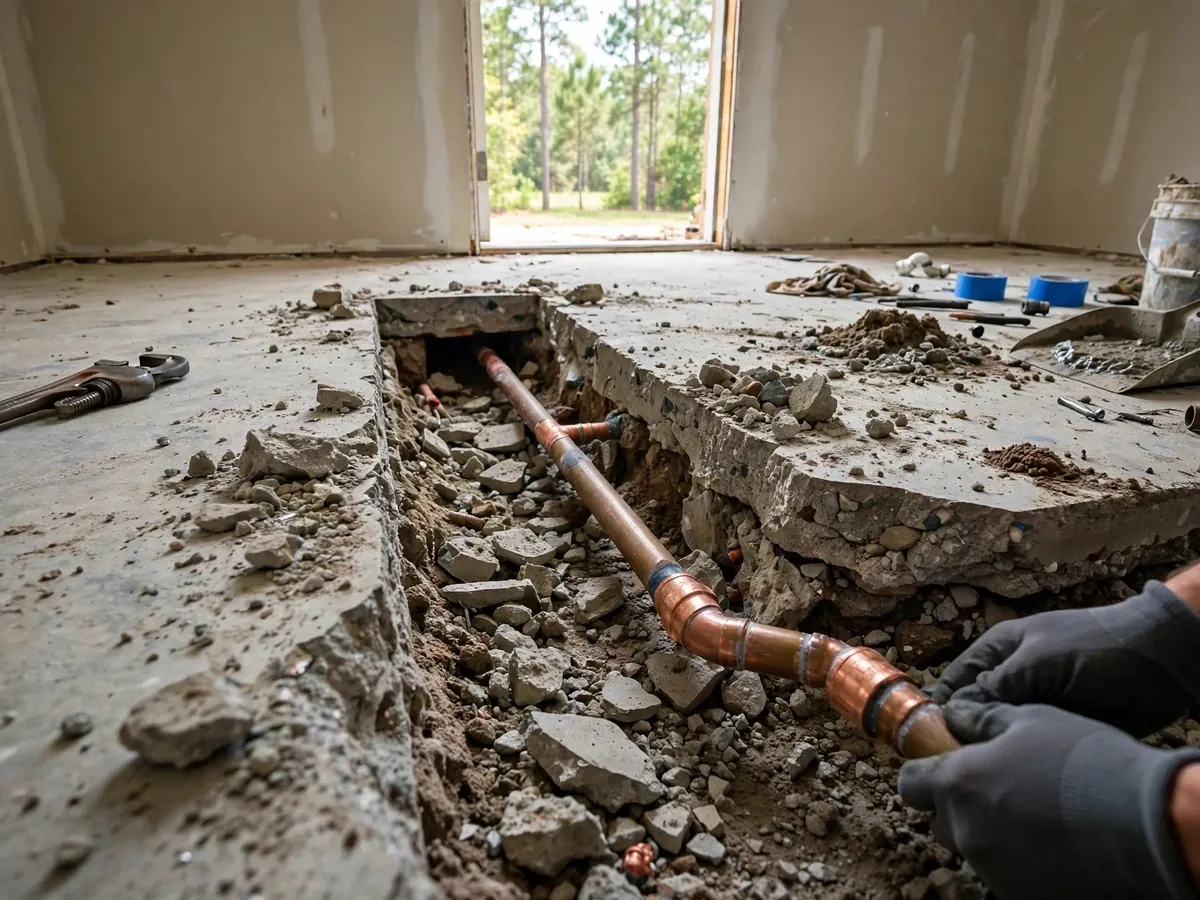
Emergency slab leak repair in Pleasanton starts with proof. Many homes here sit on a concrete foundation with supply lines running beneath it, and when one of those lines fails the water has nowhere obvious to go. It can lift flooring, soak the base of walls and drive a water bill up fast. If you suspect one, close the main valve and call (510) 544-1962.
Signs of a leak beneath the foundation
What homeowners notice first
- A warm or hot spot on the floor, often where a hot water line runs.
- The sound of water running when every fixture is off.
- A water meter that moves with the whole house shut down.
- Damp carpet, buckling wood floors or wet baseboards with no visible source.
- A sudden drop in water pressure or a hot water heater that runs constantly.
Any one of these signs can have another cause, which is why we confirm before cutting. A leak detection visit tells us whether the problem is under the slab, in a wall or in the yard.
Why under-slab pipes fail
Copper under a slab is surrounded by soil and concrete, which can wear on it from the outside as well as the inside. Aggressive water chemistry, a high flow velocity and a pipe rubbing against concrete or a neighboring line can all start a pinhole.
Soil plays a part too. Clay and silt soils like those documented in Pleasanton's Gates neighborhood swell and shrink with the seasons, and a slab that shifts even slightly pulls at the pipes below it.
Your repair options
| Option | How it works | Best when |
|---|---|---|
| Spot repair | We open the slab over the leak, replace the damaged section and patch the concrete | One leak on an otherwise sound line. |
| Reroute | We abandon the failed line and run a new one through the attic or walls | Repeated leaks or hard-to-reach pipe. |
| Repipe | Replace the whole supply system with new pipe | Aging copper with multiple failures. |
Spot repair is quickest and lowest in cost, but it only fixes the spot. If the home has had more than one slab leak, a reroute or a repipe is usually the longer-term answer, and we show you the numbers for each.
What the work looks like
The usual sequence
- We shut off the water, confirm the leak with a pressure test and mark its location.
- We protect the floors and set up dust control before opening the slab.
- The section is cut, the pipe is repaired or replaced and the repair is pressure tested.
- Concrete is patched and the area is left ready for your flooring contractor.
- We leave you a written note of the leak location and repair for your insurer and for future owners.
If the leak has soaked flooring or drywall, drying is a separate trade. We tell you when to call a restoration company and what to document first.
Slab leaks, bills and insurance
A slab leak can run for weeks before anyone knows. The City of Pleasanton's leak adjustment form says an adjustment may be available when use exceeds three times your average and the leak is on your side of the meter, with a repair invoice as proof. Requests are due within 30 days of the billing date, and only one adjustment is allowed in 36 months. We provide a written leak report.
Many homeowner policies cover resulting water damage and sometimes the access cost to reach the pipe, but not the pipe itself. Read your policy and call your insurer before work starts.
What slab leak repair costs
| Factor | Effect |
|---|---|
| Repair method | Spot repair costs less than a reroute or repipe. |
| Slab depth and floor covering | Tile, wood or thick concrete adds time. |
| Number of leaks | More failures often make a reroute more cost-effective. |
| Location in the house | A leak under a kitchen or bathroom is harder to reach. |
| Flooring repair | Restoring finished floors is usually a separate cost. |
You get the price before any concrete is cut. If the leak turns out to be in a buried line outside the house, see water line repair.
Questions we hear from callers
Yes. Call the 24/7 line, shut off the main valve and tell us what you see. We book the first visit that fits and can start with a locate.
We use pressure tests, acoustic listening gear and thermal imaging to narrow the leak to a small area. Only that spot gets opened.
A long-running leak can saturate the soil under a slab and may contribute to movement. Fixing it quickly limits the risk.
Rerouting avoids concrete work and can be a good choice for repeat leaks or hard-to-reach pipe. We compare both on price and disruption.
A spot repair is often done in a day. A reroute or repipe takes longer. We give you the timeline with the quote.
Usually not for a spot repair. A larger repipe may mean the water is off for part of a day. We plan the work to limit disruption.