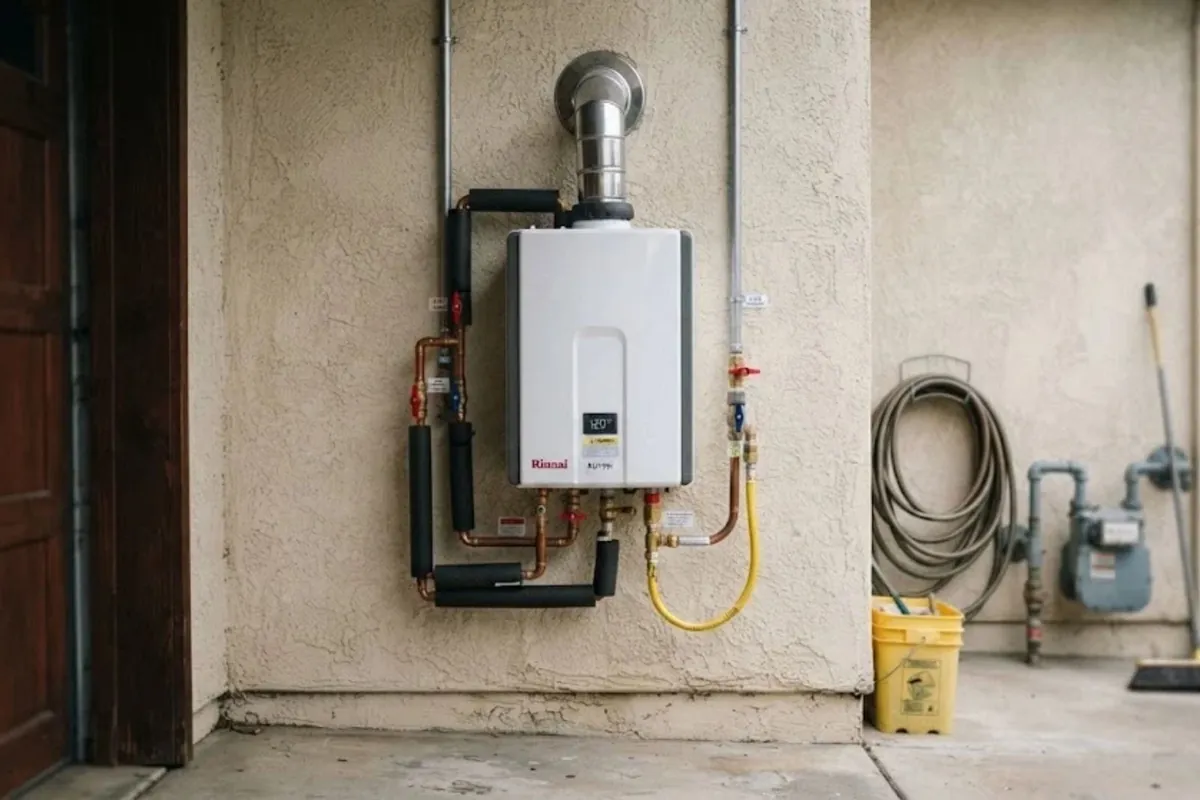
Tankless water heater service in Pleasanton comes down to three requests: install one, fix one that misbehaves, and flush one that has been running for years. The units heat water on demand, so they depend on correct gas sizing, a proper vent and clean heat exchangers. We handle all of it. Call (510) 544-1962 to book.
Gas and vent safety
What to do first: gas appliances and vents
If you smell gas, leave the house, do not touch switches, and call 911 from outside. Then call PG&E at 1-800-743-5000. A tankless unit that shows a vent or exhaust fault code should stay off until a licensed plumber checks the vent, because blocked exhaust can let combustion gases into the home.
It runs, but the hot water is not right
Most tankless calls start with a symptom, not a model number. The cold sandwich, where the water turns hot then cold then hot again, usually comes from flow dropping below the minimum the unit needs to fire. A shower that turns lukewarm when someone runs the kitchen tap points to demand exceeding the unit's rated flow. An error code with a lockout is often a flame, vent or scale problem.
None of these means the unit is bad. They mean the unit is mismatched, dirty or poorly set up. The cure is a diagnosis, not a guess.
| What you notice | Likely cause | What we do |
|---|---|---|
| Hot, then cold, then hot | Flow below the firing minimum or a clogged filter screen | Clean the screen, check flow and recirculation. |
| Lukewarm at the far fixture | Long run or demand above rated flow | Check sizing, consider a recirculation loop. |
| Error code and lockout | Flame, vent, igniter or scale issue | Read the code and test the fault. |
| Hot water takes a long time | Pipe run length with no recirculation | Add a recirculation pump or buffer tank. |
| Rumbling or whistling | Scale narrowing the heat exchanger | Flush and descale. |
Flushing and descaling a tankless heater
Flush and descale is the single most common tankless service. A pump pushes a descaling solution through the heat exchanger, dissolving mineral scale that insulates the metal and cuts flow. Manufacturers generally recommend annual service in hard water areas, and some set specific intervals in the manual.
The City of Pleasanton's 2024 water quality report lists average hardness of 86 mg/L for Zone 7 treated surface water and 309 mg/L for groundwater. Where your address sits between those depends on the blend, so test your tap. A softener ahead of the heater is the surest way to slow scale, and our water softener page covers it.
Sizing: flow rate and temperature rise
A tankless unit is rated in gallons per minute at a given temperature rise. Rise is the difference between the incoming water and your set temperature. The warmer the incoming water, the higher the flow the unit can deliver. In winter, with colder incoming water, the same unit delivers less.
Count the fixtures that might run at once, add their flow rates, and compare the total with the unit's rated flow at your rise. If the two do not match, a second unit or a larger one is the fix.
Venting a tankless heater
Tankless units vent differently from a tank. Condensing models use plastic pipe that can run through a wall and need a condensate drain. Non-condensing models use stainless vent pipe and run hotter. Vent length, elbows and termination clearance are all limited by the manufacturer, and a bad vent is the leading cause of recurring lockouts.
We check vent length and clearance during any install or repair, and we tell you if a vent needs to change before the unit is reliable.
Tank versus tankless for a Pleasanton home
| Question | Points toward tankless | Points toward a tank |
|---|---|---|
| Space | Wall space is scarce | A closet is available. |
| Hot water demand | Long, steady loads such as guests and tubs | Short bursts and small households. |
| Gas supply | Gas line can be upsized | Existing line is small. |
| Maintenance | You will flush it yearly | You prefer a simpler appliance. |
| Budget | Willing to pay more up front | Lower first cost wanted. |
What tankless service costs
| Factor | Effect |
|---|---|
| Visit type | A flush costs far less than a new install. |
| Brand and model | Parts and labor vary by manufacturer. |
| Vent and gas work | A larger gas line or a new vent changes the price. |
| Recirculation | A pump adds equipment and electrical work. |
| Hour of the call | Emergency visits cost more than scheduled service. |
Call (510) 544-1962 for the number on your unit. If the heater is a tank, see water heater repair for the symptoms that apply.
If you now have a tank and it has already failed, water heater replacement covers the emergency swap.
Questions we hear from callers
Flow is likely dropping below the unit's minimum, or a filter screen is clogged. We clean the screen, test flow and check any recirculation pump.
Many manufacturers recommend yearly service in hard water areas. Test your tap, check the manual, and we set the interval to match.
Only if the existing line can supply the unit at full burn. Many tankless units need a larger line, so we size it before quoting.
It depends on the brand. Codes usually point to ignition, flame, vent or flow faults. Tell us the brand and code, and we tell you what to check.
It can be, but the savings depend on use. A household with low demand may find a heat pump tank cheaper to run. We compare options for your usage.
Service life depends on the model and on how well it is maintained. Flushing and a softener in hard water areas help the heat exchanger last longer.