
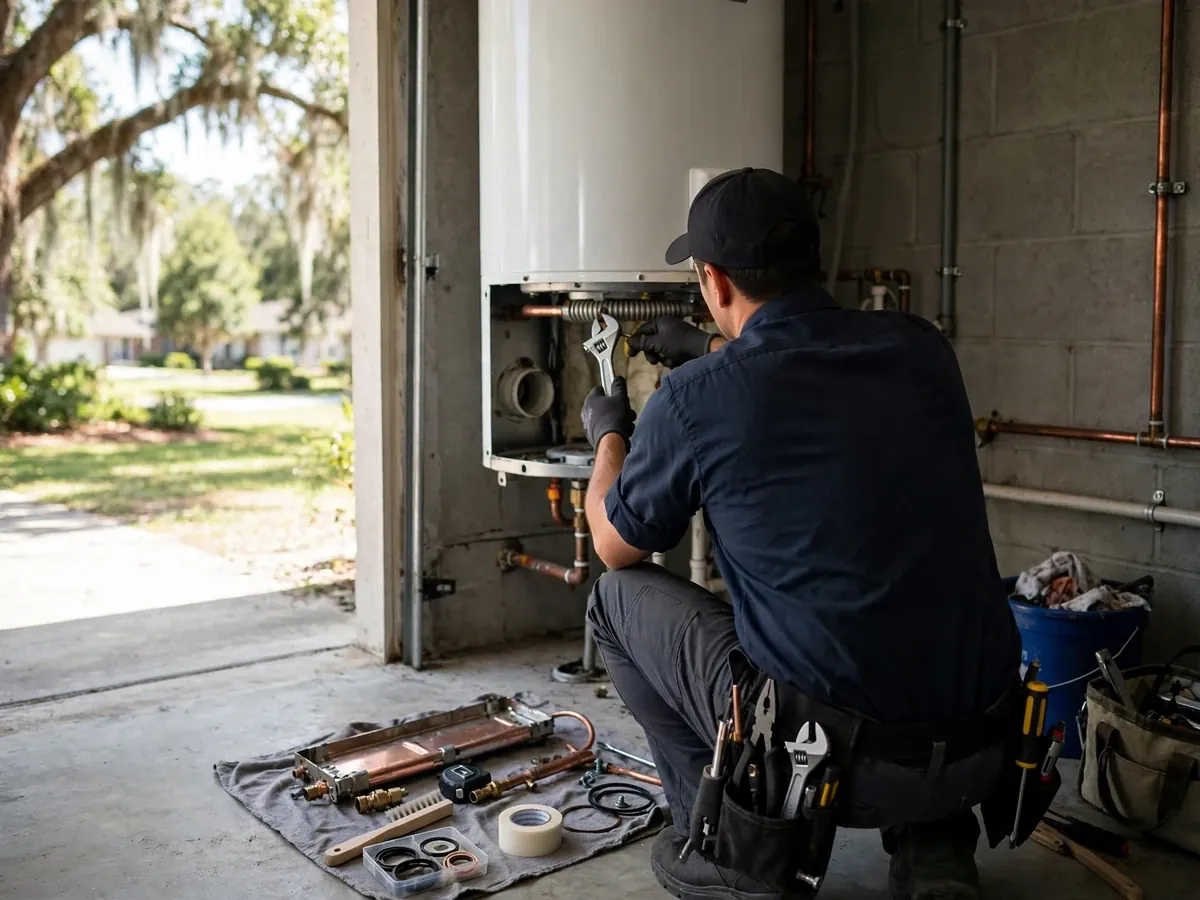
Emergency water heater repair in Pleasanton covers two very different calls. One is a heater that simply stopped making hot water, which is annoying and often a cheap part. The other is a tank that is leaking onto the floor, which can ruin a garage slab or a laundry room wall in a few hours. Our 24/7 line at (510) 544-1962 treats the second one as urgent.
If water is pooling, turn off the cold supply to the heater at the valve on top, switch off the power or set a gas unit to pilot, and open a hot tap in the house to relieve pressure. Then call.
A leaking water heater: shut it off first
The first five minutes
- Find the cold water shutoff on the pipe above the tank and turn it clockwise until it stops.
- Switch off the breaker for an electric heater, or turn a gas control to pilot or off.
- Open a hot tap upstairs to let the pressure drop.
- Run a hose from the drain valve at the bottom to a floor drain if the tank is still leaking, or place towels and a bucket.
- Move stored items away from the base and photograph the leak for your insurer.
Where the water comes from decides the repair. A drip from the temperature and pressure relief valve or a loose fitting can be fixed in place. Water seeping from the tank body or its seam means the steel has failed, and the honest answer is replacement, not repair.
No hot water: what we check
Failed heaters tend to fall into a handful of causes. On a gas unit, the thermocouple, pilot assembly or gas control valve are the usual suspects. On an electric tank, a burned heating element or a tripped high-limit switch is common. On a heat pump unit, filters, condensate drainage and the control board need attention.
A heater that makes some hot water and then runs cold quickly often has a broken dip tube or a lower element that failed. A heater that makes lukewarm water may be set too low, or sediment may be insulating the burner or element from the water.
| What you notice | Likely cause | Typical fix |
|---|---|---|
| No hot water at all, gas | Pilot out, thermocouple or control valve | Replace the part and relight. |
| No hot water at all, electric | Tripped breaker, burned element or high-limit | Test and replace the failed part. |
| Hot water runs out fast | Failed lower element or broken dip tube | Replace element or dip tube. |
| Rumbling or popping noise | Sediment baked onto the tank bottom | Flush now or replace if the tank is old. |
| Water around the base | Failed fitting, relief valve or the tank itself | Repair the fitting or replace the heater. |
Gas, electric and heat pump water heaters
Gas and electric tanks are the familiar kinds, and most repairs are quick. A hybrid heat pump heater is more efficient but has more parts, including a compressor, a fan and a condensate line, and its repair list is different. We service all three. If the manufacturer's warranty is still active on a newer unit, we explain what the warranty covers before you pay for a repair.
Repair or replace: a decision framework
| Situation | Better choice |
|---|---|
| Heater under about 8 years old, small part failed | Repair. |
| Heater past 10 to 12 years, repeated service calls | Start planning replacement. |
| Tank body leaking or corroded at the seam | Replace, repair is not possible. |
| Warranty still active on a failed component | Repair under warranty. |
| Gas unit with a failed control valve, older heater | Compare repair cost against a new unit. |
If the heater is old, our water heater replacement page explains what the swap involves and what to ask for.
Pleasanton water and your tank
The City of Pleasanton's 2024 water quality report lists average hardness of 86 mg/L for Zone 7 treated surface water and 309 mg/L for groundwater. On the USGS scale that spans moderately hard to very hard, depending on the blend that reaches your tap. Hard water leaves scale on elements and burners, which is why heaters in the Tri-Valley benefit from an annual flush.
Test your tap or read your water retailer's annual report to see where your address falls. If the number is high, a softener helps the heater last longer. Our water softener and filtration page covers that decision.
What a water heater repair costs
| Factor | Effect |
|---|---|
| Part that failed | A thermocouple costs far less than a gas control valve or a heat pump board. |
| Heater type and size | Heat pump and large tanks cost more to service. |
| Access | A heater in a tight closet or attic takes longer. |
| Hour of the visit | Night and weekend visits carry a premium. |
| Age of the unit | Old tanks may be better replaced than repaired. |
We quote before starting. If a repair would cost most of a new heater, we say so, and you decide.
Water damage and insurance
A sudden tank failure that floods a room is often covered by a homeowner policy, while a slow leak that went unnoticed may not be. Photograph everything, turn the water off, and call your insurer. We can provide a written note about the failure.
Owners of tankless units can read about flushing and error codes on our tankless water heater page.
Questions we hear from callers
Yes. The 24/7 line handles leaks and no-hot-water calls any hour. Tell the dispatcher whether water is on the floor, and we book the first visit that fits.
It could be the drain valve, a fitting or the tank. If the steel itself is leaking, the tank has failed and needs replacement. Shut off the water and power and call.
Usually not. A tank that old has little life left, and a failed part is often the first sign of more to come. We compare the repair cost with a new unit and show you both numbers.
Once a year is a good habit in areas with hard water. A flush removes sediment that insulates the element or burner. Test your tap to see how hard your water is.
Yes. We check filters, condensate drainage, the fan and the control board, and we tell you whether the manufacturer's warranty covers the fault.
For electric units, check the breaker and the red reset button. For gas units, see whether the pilot is lit and whether a gas shutoff is on. If those are fine, call us.