
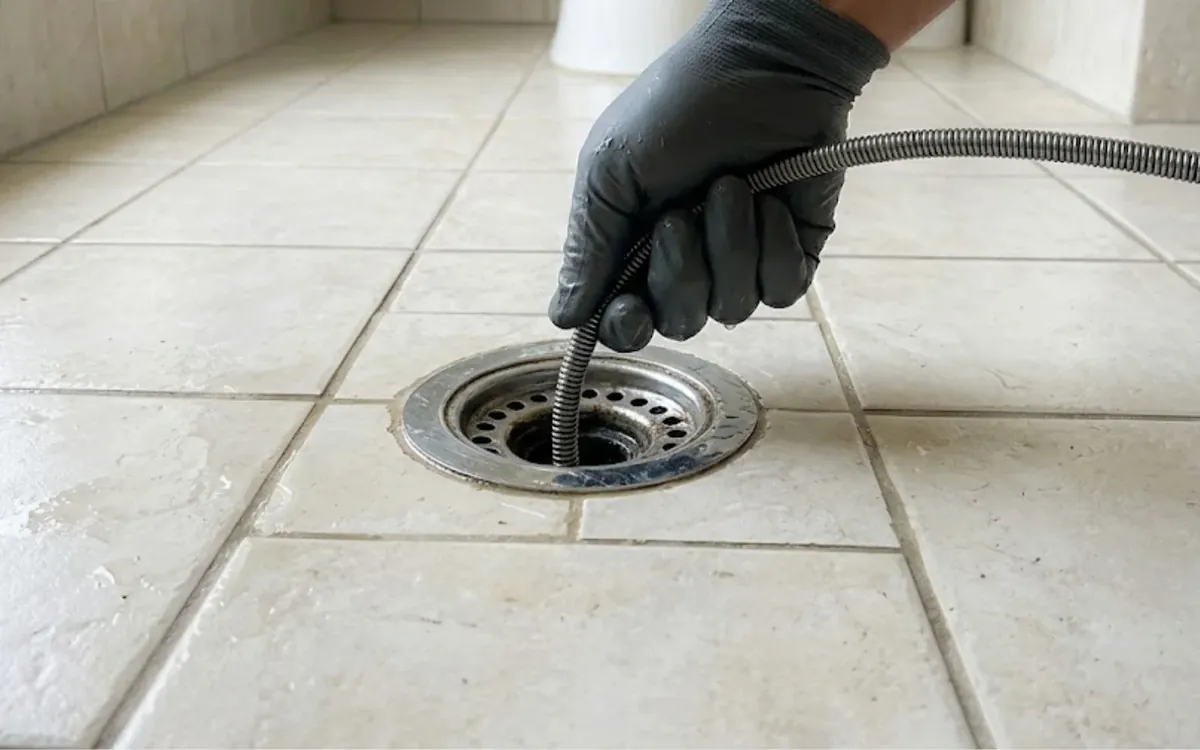
When a toilet and a shower clog at the same time, the blockage is almost always downstream of both, in the branch line or the main drain. A plunger will not reach it, and chemical drain cleaners rarely help. The best response is to stop adding water and to find out where the problem starts.
This guide helps you work out which line is blocked, what to try and what to avoid. It ends with how a plumber clears the line and how to tell whether the issue is yours or the city's.
Which line is blocked?
| What happens | Where the blockage probably is |
|---|---|
| Only the toilet is slow | The toilet trap or its own drain. |
| Toilet and nearby tub or shower are slow | The bathroom branch line. |
| Toilet flush makes the shower or tub gurgle or fill | The branch line or the main. |
| Lowest drain in the house backs up when you run the washer | The main line. |
| Every fixture is slow and a floor drain or cleanout shows water | The main line or the lateral to the street. |
The lowest drain in the house, often a shower, tub or floor drain on the ground floor, is where a blocked main shows itself first. Water has to go somewhere, and it finds the lowest opening.
What to do in the first ten minutes
Stop it from getting worse
- Stop flushing, showering, running the washer and using the dishwasher.
- Check the cleanout, a capped pipe in the yard or garage. If it is full of water, the blockage is farther down toward the street.
- Do not pour chemical cleaners into a backed-up fixture, since they sit in the standing water and are hard on pipes.
- Move rugs and valuables from the lowest floor, and cover floor drains with a heavy mat if you can.
- Call a plumber and tell them every fixture that is affected.
What a plumber does to clear it
A plumber runs a drum cable machine through a cleanout or a pulled toilet and cuts through roots, paper and debris. For heavy grease or roots on the pipe wall, hydro jetting scours the pipe. After the line is clear, a camera shows whether a break or a sag caused the problem.
If it was a one-time blockage, the repair is done. If roots or a belly in the pipe are the cause, the stoppage will return, and sewer line repair is the longer-term fix. Our sewer line cleaning page covers the process.
Common causes in older and newer homes
Why a main drain stops
- Tree roots entering joints in clay, cast iron or older plastic laterals.
- A sagging section, called a belly, that holds water and waste.
- Grease, paper and wipes that collect in a low spot.
- A cracked or offset joint that lets soil and roots in.
- A collapsed section after years of corrosion.
Homes near Downtown Pleasanton are older and are more likely to have clay or cast iron laterals with joints that roots can enter. Newer areas such as Callippe Preserve usually have plastic pipe, where a stoppage is more often from paper and wipes. A camera tells you which you have.
Preventing a repeat
Keep wipes and grease out of the drain, even when the package says flushable. Use a mesh hair catcher in showers. If your lateral is old and mature trees are nearby, a camera inspection every few years shows roots before they block the line.
Know where your cleanout is, and keep it accessible. A visible, capped cleanout cuts a plumber's time in half, and it cuts your bill. See sewer camera inspection for the process.
What not to do while you wait
Common mistakes with a main line backup
- Do not plunge a toilet or tub that is backing up from the main, since the blockage is not at the fixture.
- Do not put a small snake into a tub drain and hope to reach the main.
- Do not pour boiling water or chemicals into a backed-up fixture.
- Open a cleanout slowly and stand to the side, since sewage can spill out under pressure.
- Do not keep running water to see whether it is getting better.
If sewage reaches the floor, keep children and pets away, wear gloves and boots, and ventilate. Contaminated water on carpet and drywall needs professional drying and cleaning, and your insurer will want photos.
Where we work near Pleasanton
We serve Pleasanton and nearby towns, including Danville and Dublin. If sewage is rising into a tub or a floor drain, stop using water and call the 24/7 line. Our toilet repair page covers a single toilet that is the only problem.
Questions we hear from callers
The City of Pleasanton lists its Customer Service Center at (925) 931-5500 on weekdays and Pleasanton Police Dispatch at (925) 931-5100 after hours. If your own lateral is blocked, call us.
A small hand snake may reach a branch line, but a main line often needs a drum cable or a jetter. Forcing a small snake can also push debris deeper.
No. Water you send down a blocked line has nowhere to go, and it can rise into the lowest drain in the house.
Often yes. Roots return where a joint is open, so a lasting fix repairs the pipe or lines it.
The price depends on access, length and the method. We quote before work begins and tell you if a camera pass is recommended.