
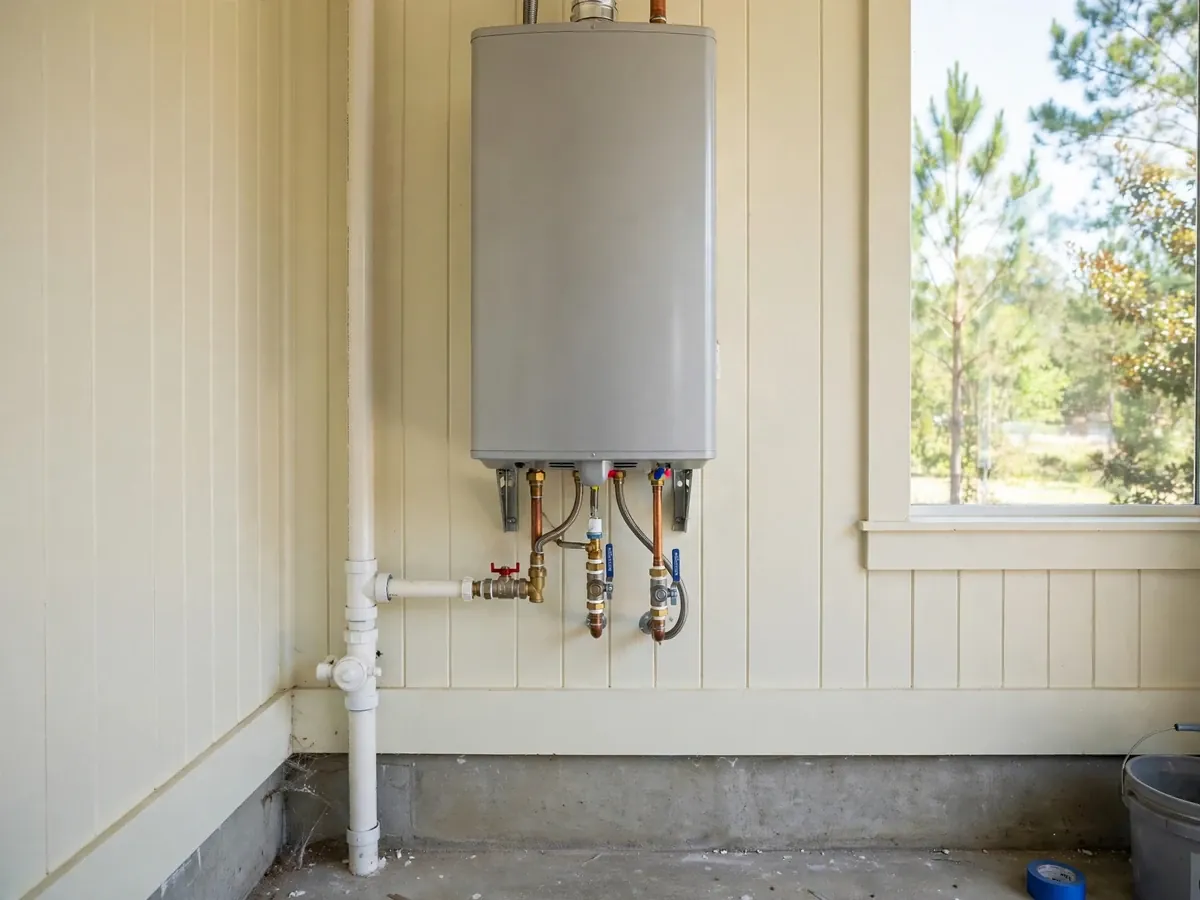
A gas tankless water heater burns fuel very hot, so it must send exhaust outdoors through a sealed vent. The vent type, length and termination point are set by the manufacturer, and the rules are strict because exhaust gas contains carbon monoxide. A vent that is too long, too narrow or too close to a window is the leading cause of lockouts and error codes.
Before you buy a unit, decide where the vent will go. Moving a tankless heater to an inside wall that has no path outdoors costs far more than keeping the old location.
Condensing and non-condensing vents
| Feature | Condensing tankless | Non-condensing tankless |
|---|---|---|
| Exhaust temperature | Lower, because heat is captured | Higher. |
| Vent material | Plastic pipe such as PVC, CPVC or polypropylene, per the maker | Stainless steel vent pipe. |
| Condensate | Produces acidic water that needs a drain or neutralizer | Little or none. |
| Run length | Can run through a wall or up a chase within limits | Shorter limits and higher clearances. |
| Efficiency | Higher | Lower. |
Condensing units are more efficient, but they need a condensate drain and often a neutralizer so the acidic water does not damage drain pipes. Non-condensing units are simpler on the drain side, but their vent runs hot and has tighter clearance rules.
Direct vent, power vent and concentric kits
A direct vent unit draws combustion air from outside and exhausts outside, usually with two pipes or one concentric pipe that has a pipe inside a pipe. That design keeps room air out of the burner and lets the heater sit in a closet or a garage.
A power vent unit uses a fan to push exhaust out. The fan allows longer runs and horizontal routes, but it needs electrical power, so the heater stops if the power fails. We tell you which kind a model needs before you commit.
What a good vent route looks like
Questions we answer before the first cut
- How far is the heater from an exterior wall or the roof?
- How many elbows are needed, since each one reduces the allowed run?
- Is the termination clear of windows, doors, air intakes and gas meters by the distances in the manual?
- Can the vent pass through the framing without damaging structure or fire blocking?
- Where will condensate go if the unit is a condensing model?
Every manufacturer publishes a maximum vent length and a table that reduces it for each elbow. Ignoring that table is a common reason for error codes after installation.
Gas supply, combustion air and the rest of the install
A tankless heater draws much more gas than a tank at full fire, so the gas line often needs upsizing. The Pleasanton gas piping handout also says each appliance needs an accessible shutoff valve, and that a new or altered gas line must be pressure tested at rough inspection.
Combustion air matters for units that are not sealed. A closet with no air supply can starve the burner and cause incomplete combustion. We check the air path, the gas line and the vent as one system, so no one part holds up the others.
When a vent change means a new location
If the old heater sat in a closet beside a flue, a tankless swap may need a new vent through the wall. If the flue cannot be reused, the work includes capping the old flue and sealing the penetration.
Homes in the newer parts of Dublin and San Ramon often have heaters in garages, where the vent route is short. Older houses with interior closets may need more work. Our tankless water heater page covers service and flushing, and water heater installation covers the planning side.
Common vent mistakes we correct
What we find on callbacks
- Mixing vent materials or brands that the maker does not approve for the same run.
- Horizontal runs with no slope back toward the unit, so condensate pools in the pipe.
- Terminations placed under a soffit vent or beside a window that opens.
- Too many elbows for the length of the run, which triggers pressure faults.
- Reusing an old flue without a liner when the unit needs its own sealed pipe.
- Vent joints that were not supported, so they sag and separate over time.
Each of these is easy to avoid at the start and costly to correct later. A vent that passes inspection on the first day can still fail a year later if the run sags, so supports matter as much as joints.
Safety checks after installation
What to confirm before we leave
- Vent joints are sealed and supported as the manual requires.
- The termination is the right distance from openings.
- A carbon monoxide alarm is present near sleeping areas.
- The gas connection has been leak tested.
- Condensate flows freely to a drain.
Questions we hear from callers
The City of Pleasanton's water heater handout says a plumbing permit is required to install, remove, relocate or replace a water heater. It does not address tankless units separately, so we confirm with the Building and Safety Division and pull the permit for you.
Sometimes, with a liner and the right adapter. Many tankless units need their own sealed vent, so check the manual before assuming the old flue will work.
It is a pipe within a pipe. The inner pipe carries exhaust out, and the outer pipe brings fresh air in. It uses one wall penetration instead of two.
A blocked vent, a vent run that is too long or a failed pressure switch can all cause it. We inspect the run and the fan.
Alarms are a safety standard in homes with gas appliances. The Pleasanton gas piping handout mentions smoke and CO alarm verification at final inspection.