
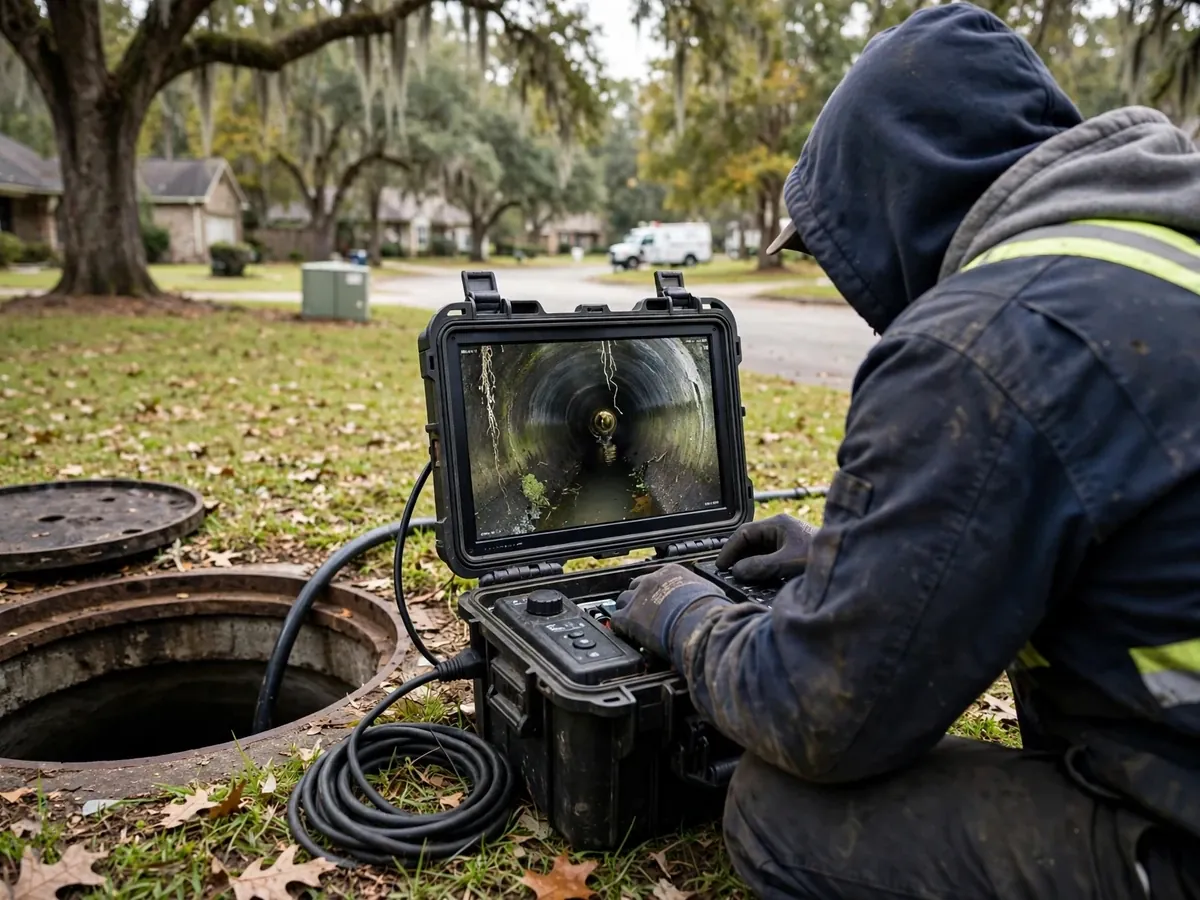
A main sewer line inspection uses a waterproof camera on a flexible cable that travels from a cleanout or a pulled toilet toward the street. It records roots, cracks, offsets, low spots and buildup, and it measures how far each defect sits from the entry point. The result is a video and a plain report.
The inspection is worth doing when you are buying a home, after a backup, when you see slow drains with no clear cause or when your house is old and mature trees stand nearby. It is not needed on every house every year.
What the camera can show
| Finding | What it means | Usual next step |
|---|---|---|
| Roots through a joint | Water is escaping and roots are following it | Clear and monitor, or repair. |
| Offset joint | Pipes have shifted, and the lip catches paper | Spot repair if it blocks flow. |
| Belly or sag | A low spot holds water and waste | Repair if it causes repeat blockages. |
| Crack or break | The pipe has failed in one place | Spot repair or lining. |
| Heavy scale or grease | Buildup narrows the pipe | Hydro jetting. |
| Clean and intact pipe | No action needed | Keep the report on file. |
The report is as useful for what it does not find. A clean, continuous pipe lets you skip repairs and shows a buyer that the line has been checked.
When an inspection pays for itself
Reasons to scope the line
- You are buying a house, and the sewer lateral is older than thirty years.
- You have had a backup or repeated slow drains.
- You see lush green patches or wet ground in the yard along the line.
- Large trees stand near the lateral and the house is older.
- You are planning a remodel that adds fixtures to the existing line.
What an inspection involves
The visit, start to finish
- The plumber finds the cleanout, or pulls a toilet or uses a roof vent if none exists.
- The camera is fed through the pipe while a screen shows the view and a locator tracks distance and depth.
- Defects are noted with their distance and position, and the plumber marks the ground above important findings.
- You see the footage, and the plumber explains what each item means.
- A written report with photos is sent to you for your records.
Reading the footage and the report
A good report names the material of the pipe, the length inspected, the location of each defect and your options. Cast iron often shows scale and rust, clay shows joint offsets and root intrusion, and plastic pipe shows sags or cracks from poor bedding.
Ask for the video as well as the PDF. If you are buying a home, the video lets your own plumber or inspector give a second opinion, and it helps you negotiate a repair credit.
Keep the footage after the visit, even when the news is good. A clean recording from this year is a baseline, and a second inspection in a few years shows whether roots or sags are moving. Store the file with your closing papers so the next owner can see it too.
Repair choices after an inspection
| Condition | Common option | Notes |
|---|---|---|
| Minor roots or buildup | Cable cleaning or hydro jetting | Recheck in a year or two. |
| One short bad section | Spot repair with excavation | Often a day of work. |
| Long run with several defects | Pipe lining or replacement | Depends on access and pipe size. |
| No defects | Keep the report | Compare with a future camera pass. |
Our sewer line repair page explains spot repair, lining and replacement, and our hydro jetting page covers cleaning that keeps a sound pipe flowing.
Questions to ask before you hire an inspector
What a good inspection includes
- Do you give me the full video and a written report, or only a summary?
- Does the camera have a locator so you can mark depth and position above ground?
- Will you note the distance of every defect from the cleanout?
- What happens if the camera cannot pass a blockage or a break?
- Is cleaning included if the pipe is dirty, or is that a separate charge?
- Will you tell me plainly which findings need action and which do not?
The best inspectors recommend the least work the pipe needs. A report that lists every flaw with no ranking leaves you guessing, and a report that tells you what to repair now, what to watch and what to ignore saves money.
Ask the same questions of any company that offers to scope your line, including ours. We would rather you know what you are buying than discover it on the day.
Where we work near Pleasanton
We inspect sewer lines in Pleasanton and nearby towns, including Livermore and San Ramon. Our sewer inspection page lists what you receive.
Questions we hear from callers
The city's plan says it may provide maintenance on laterals within the public right of way as a courtesy where a cleanout exists. It does not repair laterals on private property, so call the city to ask before assuming.
Many take one to two hours, depending on access and length. A pulled toilet or a missing cleanout adds time.
It shows what is inside the pipe along the route it travels. A blocked or collapsed section can stop the camera, and the report notes where it stopped.
In an older house with mature trees, yes. It costs far less than a lateral replacement and it can help you negotiate.
If it is old, has had backups or sits near large trees, every few years is reasonable. A new plastic lateral may not need it for a long time.