
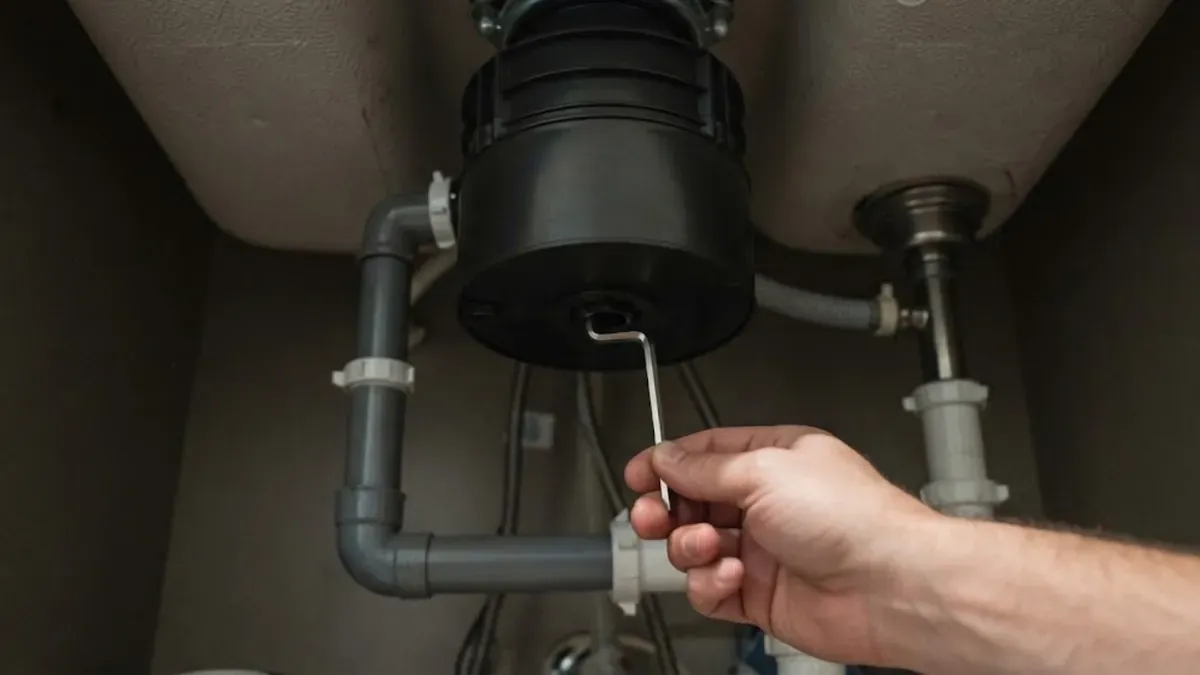
A garbage disposal that hums but does not spin is jammed, and one that makes no sound at all has usually tripped its reset button. A disposal that leaks has a failed seal, a loose flange or a cracked housing. Each problem has a different fix, and the first job is to find which one you have.
Never put your hand in the unit, even when it is off. Use tongs, pliers and a flashlight to see inside, and switch off the power at the wall or the breaker before you do anything else.
What the symptom tells you
| Symptom | Cause | Fix |
|---|---|---|
| Hum, no spin | Jammed flywheel | Free it with the hex key and press reset. |
| No sound or lights | Tripped reset or dead outlet | Press reset, check the switch and breaker. |
| Spins but grinds badly | Dull or damaged shredder or foreign object | Remove the object, consider replacement. |
| Leaks from the top | Loose sink flange or failed gasket | Reseat the flange and replace the seal. |
| Leaks from the side or bottom | Cracked housing or failed internal seal | Replace the unit. |
| Drains slowly with the disposal off | Clogged trap or kitchen line | Clear the line. |
The safe reset, in order
- Switch the disposal off at the wall and unplug it under the sink if you can reach the cord.
- Look into the sink with a flashlight. Use tongs to remove any visible object, such as a bottle cap or a utensil.
- Place the hex key from the unit's box into the socket at the center of the bottom, and turn it back and forth until the flywheel moves freely.
- Press the red reset button on the bottom of the unit.
- Restore power, run cold water and test. If the unit trips again, stop and call.
Leaks and where to look
Wipe the unit dry, then run water and watch where the first drop appears. A leak at the top, where the sink meets the disposal, points to the flange putty or gasket. A leak at the hose that goes to the dishwasher points to a loose clamp. A leak from the bottom means the unit is done.
Do not wait on a leak, because water in the cabinet softens the base and grows mold. Place a bucket under it and put down towels if you have to run the sink before the repair.
Kitchen habits that keep a disposal working
What to feed it and what to skip
- Run cold water before, during and for about fifteen seconds after use.
- Feed small pieces gradually, not a full sink at once.
- Keep grease, oil and fat out of the drain, since they coat the pipe.
- Skip fibrous items such as celery, corn husks and artichoke leaves, and use coffee grounds sparingly.
- Never put bones, pits, glass, metal or non-food items in.
Repair or replace
| Situation | Better choice |
|---|---|
| Jam, tripped reset or loose connection | Repair. |
| Leak from the top flange | Repair if the housing is intact. |
| Leak from the housing | Replace. |
| Unit over about ten years old and tripping often | Replace. |
| Frequent clogs from a weak motor | Replace with a higher-horsepower model. |
A half horsepower unit suits light use, and three quarters to one horsepower suits a busy kitchen. The model should fit your sink mount, and it needs a switched outlet or a hardwired connection.
When the problem is the drain, not the disposal
If water backs up in the other sink when the disposal runs, the kitchen line is partly blocked. A new disposal on a blocked line will back up again. A plumber can clear the line with a cable or hydro jetting, and our drain cleaning page covers the process.
Our garbage disposal repair team checks the drain and the dishwasher connection on every visit, since both share the same trap.
What a replacement visit involves
A typical swap
- The power is switched off and the old unit is unhooked from the drain, the dishwasher hose and the electrical connection.
- The mounting ring is released, and the old unit is lifted out of the sink flange.
- The new flange is set with plumber's putty or a gasket, and the new unit is hung from the mounting ring.
- The discharge pipe, trap and dishwasher hose are reconnected, and the dishwasher knockout plug is removed if the unit is new.
- Power is restored, and the plumber runs water and checks every joint for drips.
A straightforward swap takes an hour or two. The surprises are an outlet that is not switched, a cabinet that is too tight for a larger unit or a drain that needs work. We check those before we quote.
Where we work near Pleasanton
We serve Pleasanton and nearby towns, including Livermore and San Ramon. Call the 24/7 line if the sink will not drain and you cannot cook.
Questions we hear from callers
Both can work. The City of Pleasanton says food and plant waste goes in the green cart, and state law requires keeping compostable materials out of landfills. Bulky, fibrous and greasy scraps are better in the cart than down the drain.
The flywheel is jammed. Switch it off, use the hex key in the bottom socket to free it and press the reset button.
We advise against it. Chemicals can damage seals and splash back, and a plumber can clear the line without them.
Many last ten years or more with good care. A leak from the housing means it is time for a new one.
It is possible with a few tools, but you must handle the electrical connection and the drain plumbing correctly. We install them and check the dishwasher connection.