
The first priority with a burst pipe is to stop the water, and the second is to make the house safe. A pipe under pressure can release many gallons a minute, enough to soak flooring and drywall in less than an hour. Close the main shutoff, relieve the pressure and then call a plumber.
This post is organized in time order so that you can follow it with a phone in your hand. Do not spend the first minutes trying to find the break. Stop the water first.
Minutes 0 to 5: stop the water
The shutoff sequence
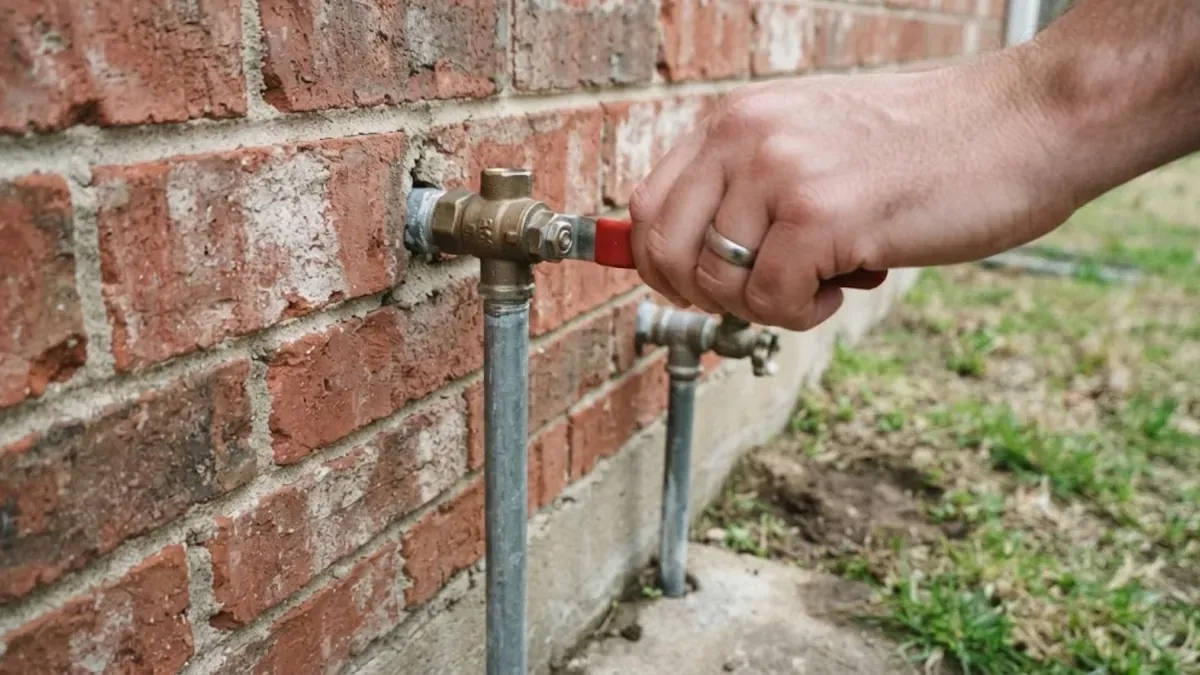
- Close the main shutoff valve. In most homes it is near the water heater, in a garage wall or where the line enters the house. If you cannot find it, use the valve at the meter with a meter key or a pair of pliers.
- Turn the water heater to off or pilot, since a heater with no water coming in can overheat.
- Open the lowest faucet in the house and flush a toilet to drain the line.
- If water is near outlets or light fixtures, switch off the breaker only if you can reach the panel without stepping in water.
- Call a plumber and describe where the water is coming from.
Minutes 5 to 20: contain and document
Move rugs, furniture and electronics out of the wet area, and place towels or a wet vacuum at the lowest point. Open cabinet doors under the sink if the leak is there, so air can reach the framing. Take photos and a short video of the source and the damage before you start cleanup.
If the ceiling below is bulging with trapped water, stand to the side and poke a small hole at the lowest point into a bucket to let it drain safely. A bulge can fail suddenly, and the plaster is heavy.
Minutes 20 to 60: call, confirm and plan
Call your insurer once the water is stopped, and ask about mitigation steps they require. Many policies expect you to prevent further damage, and they may recommend a drying company. A plumber then repairs or replaces the failed section and checks pressure so the cause does not return.
If the pipe is buried, in a slab or inside a finished wall, the first step is finding it. Our leak detection page explains the tools, and slab leak repair covers the options when the break is under the floor.
| Cause | How it fails | What we check |
|---|---|---|
| Corrosion in aged pipe | Pinholes that grow into a split | Condition of the rest of the line. |
| High water pressure | A joint or fitting gives way | Pressure with a gauge. |
| Cold snap | Water freezes in an exposed pipe | Attic, garage and exterior walls. |
| Failed fitting | A joint leaks and then separates | Fittings from the same batch. |
| Ground movement or impact | A buried line cracks | Route and depth of the line. |
After the repair: drying and mold
What to do in the next few days
- Start drying right away with fans and a dehumidifier, and open windows if the weather allows.
- Remove soaked carpet pad and wet drywall that cannot dry in place.
- Check for musty smells and discoloration for a week or two.
- Keep every receipt for drying, repairs and temporary housing.
- Ask your plumber to write down what failed, where and what was done.
Mold can start to grow in a day or two in wet drywall and insulation, depending on temperature and airflow. Drying quickly and removing what cannot be saved lowers that risk. A restoration company can measure moisture and tell you what is safe to keep.
Preventing the next one
Know where your main shutoff is, and test it once a year so it turns when you need it. If it is stuck or leaks around the stem, have it replaced, since a shutoff that does not close is the worst failure in an emergency.
A pressure regulator that has failed lets street pressure into your pipes, and fittings give way. Have pressure tested, and consider a smart leak sensor under sinks and near the heater. If the pipes are old and failing in several places, look at whole house repiping.
What to tell the plumber on the phone
Details that speed up the visit
- The address, and whether the water is shut off at the main.
- Where the water is coming from and what material the pipe looks like.
- Whether the pipe is in an open space, a wall, a ceiling or under the floor.
- The age of the house and any past leaks or repairs.
- Whether you can safely reach the electrical panel or whether water is near outlets.
The more specific the description, the better the plumber can bring the right pipe, fittings and tools. A split in an exposed copper pipe in the garage is a different job from a failed fitting inside a finished wall.
Where we work near Pleasanton
Our plumbers serve Pleasanton and nearby towns, including Livermore and San Ramon. Our burst pipe repair page covers the repair, and the 24/7 line takes calls at any hour.
Questions we hear from callers
It may be possible. The City of Pleasanton's form requires use above three times your average, a leak on your side of the meter and proof of repair, with the request received within 30 days of the billing date. Only one adjustment is allowed in 36 months.
Look where the water line enters the house, near the water heater or in a garage wall. Many homes also have a valve at the meter box.
Yes. Switch off the power or set the gas control to pilot so the heater does not run without water.
Many policies cover sudden water damage but not the pipe itself. Call your insurer right away and keep photos and receipts.
An accessible pipe is often fixed the same day. A buried or slab line takes longer because it must be located first.